
Over the past several months, I have had the opportunity to support work adjacent to large-scale data center infrastructure expansion.
This most recent experience reinforced a realization that I suspect many in the industry are already confronting:
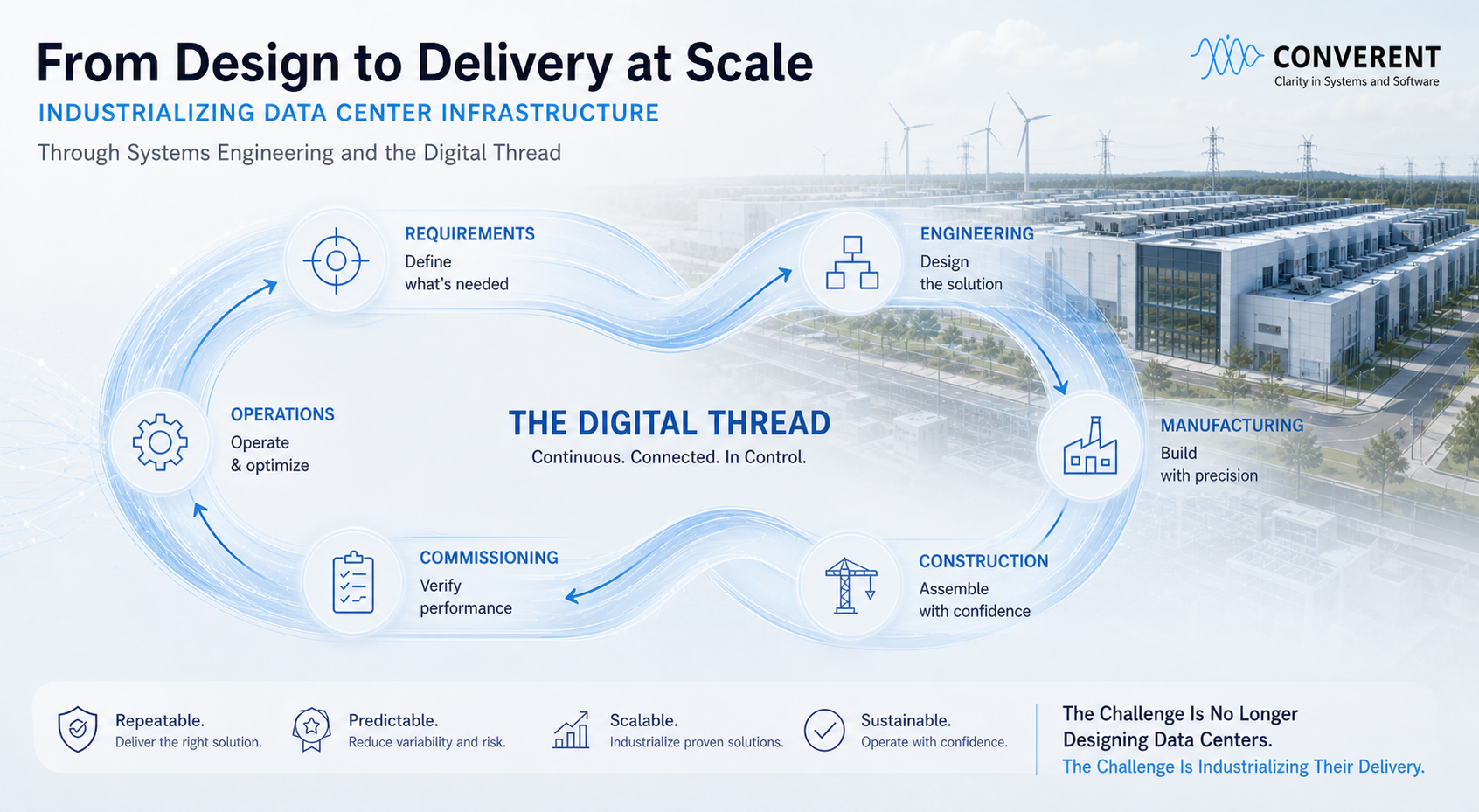
The challenge is no longer simply designing data centers. The challenge is industrializing their delivery.
Much attention is rightly focused on power generation, utility infrastructure, grid capacity, and site availability. Those are critical constraints and will continue to shape the pace of data center expansion.
However, setting the utility problem aside for a moment, there is another significant systems challenge emerging.
How do we consistently deliver proven infrastructure solutions across multiple suppliers, manufacturing sites, construction teams, and operating environments while maintaining quality, schedule, configuration control, and performance?
Engineering a solution once is difficult.
Building the capability to deliver that solution repeatedly, predictably, and at scale is often the greater challenge.
As demand for AI and digital infrastructure accelerates, many industrial suppliers appear to be moving along a maturity curve:
Custom Engineering → Reference Designs → Standardized Modules → Repeatable Manufacturing → Multi-Vendor Production → Industrial Scale Deployment
Success on the left side of that curve depends heavily on engineering expertise.
Success on the right side depends on transferring knowledge into manufacturing processes, procurement activities, supplier deliverables, construction practices, commissioning procedures, and operational teams without degradation of quality or intent.
This is where I see significant potential for Model-Based Systems Engineering and the digital thread.
Not simply as an engineering tool.
Not as a modeling exercise.
But as a governance framework that maintains continuity from capacity objectives through architecture, procurement, manufacturing, deployment, commissioning, and operations.
The traditional lifecycle is often treated as a series of handoffs:
Requirements → Engineering → Manufacturing → Construction → Commissioning → Operations
Each handoff introduces opportunities for information loss, interpretation error, local optimization, configuration drift, and unnecessary variability.
A well-implemented digital thread can help maintain traceability and decision continuity across those boundaries. It can provide a shared reference for what is being delivered, why it is configured that way, how it is verified, and how it should be operated.
That becomes increasingly important as suppliers transition from a build-to-order or assembly-to-order mindset toward a more scalable industrial delivery model.
The objective is not simply to produce more equipment.
The objective is to repeatedly produce the right equipment, to the right specification, with consistent quality, reduced manual oversight, fewer specialist-dependent interventions, and clearer verification of readiness.
If this sounds familiar, the automotive industry provides a useful reference point.
Automotive has spent decades trying to scale complex products across global supplier networks, manufacturing sites, product variants, and regulatory environments. Even with mature processes, quality systems, engineering standards, and significant investment in digital tools, the industry continues to wrestle with specification interpretation, manufacturing variation, supplier capability, change management, lifecycle traceability, and quality escapes.
The lesson is not that the problem is unsolvable.
The lesson is that industrial-scale delivery is itself a systems engineering problem.
Data center infrastructure may now be encountering a similar scaling challenge. Not necessarily at automotive production volumes, but certainly at a scale where repeatability, supplier interoperability, manufacturing readiness, configuration control, commissioning efficiency, and lifecycle governance become strategic concerns.
In many ways, the opportunity is less about creating better individual data center designs and more about creating better systems for delivering proven designs repeatedly, predictably, and at scale.
This is where MBSE and digital thread approaches may provide significant value.
They can help connect:
- Capacity objectives
- System requirements
- Reference architectures
- Equipment configurations
- Procurement specifications
- Supplier deliverables
- Manufacturing readiness
- Inspection and verification activities
- Construction sequencing
- Commissioning criteria
- Operational acceptance
- Lifecycle change management
The opportunity is not just technical. It is organizational.
It is about creating continuity between engineering intent, manufacturing execution, supplier capability, field deployment, and operational performance.
I would be interested in speaking with others working in this area, particularly those exploring the intersection of:
- Systems Engineering
- MBSE and Digital Thread technologies
- Manufacturing Readiness
- Supply Chain and Procurement Integration
- Industrialized Infrastructure Delivery
- Commissioning and Operational Readiness
- Data Center and AI Infrastructure Programs
There appears to be a significant systems engineering opportunity here, and I would welcome discussion with those actively working on these challenges.